
First-Week Friendship Trouble: Conflict, Unkindness or Bullying?
A parent guide for sorting out friendship conflict, one-time unkind behavior and bullying patterns during the first week of school.

The first week can produce fast friendships, misunderstandings and painful exclusions. Parents need language that takes a child’s feelings seriously without labeling every disagreement as bullying. Looking at repetition, power and the child’s ability to resolve the situation safely helps adults choose the right response.
Describe what happened before choosing a label
Ask for the sequence: what happened first, what each person did, whether it occurred before and what the child tried. Conflict often involves students with relatively equal power who can participate in a solution. Bullying involves aggressive behavior and a real or perceived power imbalance, repeated or likely to be repeated.
One-time cruelty still deserves attention even when it does not meet a bullying definition. The response should match the behavior and its impact rather than depend only on a label.
Check for hidden power differences
Power can come from popularity, age, size, social information, technology access, group numbers or a student’s vulnerability. A child may appear able to respond while privately fearing retaliation or wider exclusion.
Ask what the child thinks will happen next. That question can reveal whether a mutual conversation is realistic or whether adult protection and investigation are needed.
Choose a response that fits
A misunderstanding may improve through coaching, space or a school-supported conversation. Repeated targeting or a power imbalance requires adult-led reporting, safety planning and follow-up. Do not require a targeted student to meet face-to-face with the other student.
For online behavior, avoid public replies and preserve relevant context. Families should use school and platform processes where appropriate.
Follow the pattern over time
The first report may not contain every detail. Keep brief notes and ask the child what changed after adults responded. Coordinate with staff who see different parts of the day.
Review whether the child feels safe, can participate and knows whom to contact. A disciplinary action alone does not replace support or ongoing prevention.
Help children describe events without forcing a label
Friendship conflict can hurt even when it does not meet a school's definition of bullying. Ask for the sequence, how often it happens and whether each person can speak up or leave. A disagreement between students with similar power may call for communication support; repeated targeted aggression with a power imbalance may need a formal school response. A label should not be required before a child can ask an adult for help.
Avoid saying “just drama” or insisting that every conflict is bullying. Both responses can close a conversation. Validate the feeling while gathering facts: “That sounds hurtful. What happened next?” Ask whether the child feels safe, what they have tried and which adult could help. One-time cruelty still deserves attention; the response should fit its impact.
If the school becomes involved, ask staff to assess the pattern under its policy and explain the next step. Encourage the child not to retaliate or post about another student online. Check whether behavior stops, changes form or continues in a different setting. Brief notes over time help adults understand whether a conflict is resolving or becoming repeated. A school-supported conversation may be useful only when both students can participate freely; it should never replace safety measures where a child fears retaliation.
Key Takeaways for Schools
Describe behavior before labeling
Look for power differences
Match the response to the pattern
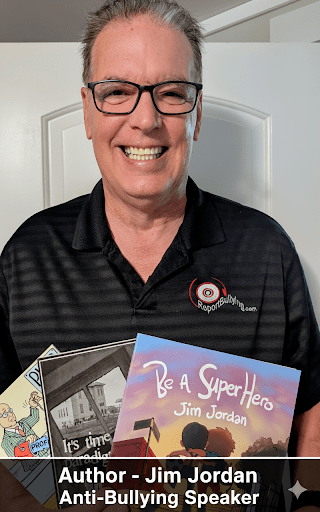
Featured Anti-Bullying Speaker
Jim Jordan — Bullying Prevention & Mental Health Speaker
Jim Jordan delivers grade-specific anti-bullying assemblies for U.S. schools, with teacher training and parent presentations available for a schoolwide approach. Schools can compare programs and contact the office to discuss audience fit, current pricing and availability.
Jim Jordan is a bullying-prevention and mental-health speaker for U.S. schools, with separate presentations by grade band plus teacher training and parent education options.
Frequently Asked Questions
Is one mean comment bullying?
It may be hurtful and require a response, but bullying generally involves repetition or likelihood of repetition plus a power imbalance. Context matters.
Can friends bully each other?
Yes. A friendship does not rule out bullying when aggressive behavior, repetition and a power imbalance are present.
Is mediation always appropriate?
No. Mediation assumes relatively equal power and safe participation. It may be inappropriate in a bullying situation or when a student fears retaliation.