
Build a Family Bullying Reporting Plan Before the School Year
Create a simple family plan for reporting bullying, preserving information, contacting the school and following up throughout the new school year.

Families often make a reporting plan only after a stressful incident. A short plan created before school starts can reduce panic and help a child know that asking for help will lead to calm, predictable support. The plan should fit the school’s actual procedures and be simple enough to remember.
Find the real reporting pathway
Review the student handbook or district website for bullying, harassment, discrimination, transportation and online conduct procedures. Record the names or roles of the first school contact and the backup contact.
Check whether an online form is monitored outside school hours and how urgent safety concerns should be handled. Do not assume an anonymous form can provide immediate help.
Agree on what the child will do
The child’s plan might be: move toward a supervised area, contact a trusted adult, avoid retaliation, preserve relevant online information and tell a parent. Adapt the steps for age, disability, transportation and communication needs.
Practice one sentence for routine concerns and one for urgent danger. Make clear that the child does not need to gather proof or confront the other student before receiving help.
Agree on what the parent will do
Promise to listen before acting, protect the child’s privacy and explain the next step. Parents should record facts, communicate through designated channels and avoid public accusations or direct confrontations.
Ask the school to confirm receipt, identify a point of contact and provide a reasonable follow-up time under local procedure. Focus requests on safety, access to learning and prevention of retaliation.
Review the plan after it is used
A plan is not complete when the email is sent. Check whether the child knows what to do the next day, whether interim supports started and whether new incidents occurred.
After the situation stabilizes, update contact names and lessons learned. Keep the plan available for the family without turning normal school life into constant surveillance.
Make the reporting plan usable under stress
A plan should match the child's age and the school's actual procedures. Write down the first school contact, an alternate adult, the preferred reporting method and a family follow-up date. Younger children may need a short spoken sentence; older students may prefer a private message or meeting. Store the plan where parent and child can find it, and update it when schedules change.
Explain which details help: what happened, where and when, who was involved, who saw it and whether it happened before. A child does not have to investigate or collect proof before asking an adult for help. Parents can preserve relevant messages and add context while leaving the school's investigation to responsible staff.
After reporting, ask for confirmation and a clear point of contact. Record the date and agreed next step. If the concern continues, share new facts and ask how to use the next level of the school or district process. Revisit whether the child knows what to do the next day and whether interim support is in place. Keep a private record of school conversations and decisions, and send a short factual recap after a meeting so everyone has a shared understanding. A report begins follow-up; it does not complete it.
Key Takeaways for Schools
Record the school's real reporting route
Give the child simple safe steps
Track receipt and follow-up
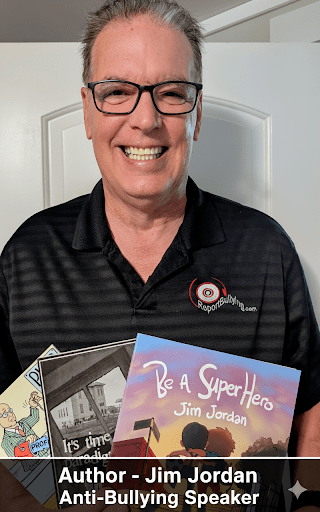
Featured Anti-Bullying Speaker
Jim Jordan — Bullying Prevention & Mental Health Speaker
Jim Jordan delivers grade-specific anti-bullying assemblies for U.S. schools, with teacher training and parent presentations available for a schoolwide approach. Schools can compare programs and contact the office to discuss audience fit, current pricing and availability.
Jim Jordan is a bullying-prevention and mental-health speaker for U.S. schools, with separate presentations by grade band plus teacher training and parent education options.
Frequently Asked Questions
Should every concern be reported as bullying?
Report the behavior and facts accurately. School staff can apply definitions and procedures; families do not need a perfect label to request support.
Is anonymous reporting enough?
Anonymous tools can help, but they may limit follow-up and may not be monitored continuously. Urgent safety concerns need direct, immediate contact.
What should parents request from the school?
Ask for confirmation, a point of contact, immediate safety steps when needed, the applicable process and a follow-up date.