
How to Choose an Anti-Bullying School Speaker
A practical guide for principals and school leaders choosing an anti-bullying school speaker, including age fit, safety, follow-up, staff alignment and questions to ask before booking.

Choosing an anti-bullying school speaker is not the same as booking general entertainment for an assembly. The person on stage may have less than an hour with students, yet the message has to fit your grade levels, support the language your staff already uses, avoid unsafe advice and leave students with realistic next steps. A polished video reel can tell you whether a speaker is engaging. It cannot tell you whether the program is developmentally appropriate, whether students are taught to seek adult support, or whether the school will have anything useful to reinforce after the applause ends. The best decision starts with the learning goal, not the personality of the presenter.
Start with the student behavior you want to strengthen
Before comparing speakers, decide what students should understand or do differently after the program. A school may want younger students to recognize repeated harmful behavior and identify trusted adults. A middle school may want students to stop rewarding rumor cycles, exclusion and group-chat pile-ons. A high school may want a more mature discussion about reputation, retaliation, digital permanence and how to support a peer without escalating the situation. Those goals are specific enough to evaluate. A vague goal such as 'inspire kindness' is harder to measure and easier for a speaker to satisfy with a generic motivational talk.
Ask each speaker to explain the practical student takeaways in plain language. Strong answers usually sound like actions: do not join harmful behavior, support the student being targeted, preserve evidence when needed, get a trusted adult, and use the school's reporting process. Be cautious when the answer depends mostly on emotion, slogans or a promise that one event will change the entire culture. An assembly can create a shared moment, but schoolwide prevention still depends on supervision, policy, staff response, counseling, family communication and follow-up.
Check whether the content changes by age group
An elementary student and a high school senior should not receive the same examples, pacing or language. Younger children often need concrete stories and reassurance that telling a trusted adult for safety is different from tattling for advantage. Middle school students need the speaker to acknowledge social pressure, online behavior and fear of becoming the next target. Older students generally respond better when the program respects their maturity and addresses nuanced situations instead of reducing everything to simple labels.
Ask how the speaker changes stories, humor, terminology and calls to action for each grade band. If your school serves several ages, find out whether the presenter can deliver separate sessions or clearly adapted versions. A consistent prevention philosophy is useful across a district, but developmental fit matters. Students notice immediately when material feels childish, and younger students can become confused when examples assume social situations they have not yet encountered.
Evaluate the safety of the advice students will hear
Some bullying-prevention messages sound courageous but place too much responsibility on students. Telling every bystander to confront an aggressor can be unsafe when there is physical intimidation, a power imbalance or fear of retaliation. A better program gives students several options: get an adult, support the targeted student privately, refuse to laugh or share, leave a harmful group interaction, or use a school reporting channel. The message should make clear that adults remain responsible for investigation, discipline and safety planning.
Also ask how the speaker handles disclosures. A strong assembly may prompt students to recognize something they want to report. The presenter should not invite public accusations or turn the auditorium into an open-microphone investigation. Your school should have counselors or designated staff prepared to receive concerns privately after the event. That handoff is one of the most important parts of assembly planning and should be discussed before the speaker arrives.
Look for a plan that includes teachers and families
The speaker should be able to explain what happens after assembly day. That does not require an elaborate curriculum. A useful follow-up might include a one-page staff summary, two or three classroom prompts, a caregiver recap and reminders about trusted adults. What matters is that the language can be repeated without recreating the entire presentation. Students benefit when the same core actions are reinforced by teachers, counselors, coaches and families.
If staff training or a parent presentation is available, consider whether those pieces fit your goals. Adults often need a different conversation than students. Teachers may need help with receiving disclosures, documenting concerns and avoiding promises they cannot keep. Parents may need guidance on listening without escalating conflict online, preserving relevant information and contacting the school through the correct channel. An integrated approach can make the student assembly more coherent because the adults around students understand the same prevention framework.
Ask for evidence of professionalism, not impossible guarantees
A professional speaker should be able to provide clear program descriptions, technical needs, scheduling information, references or verifiable testimonials, and a transparent booking process. You should know what the school is buying, how long each session runs, which grades are appropriate and what materials are included. Videos from real school presentations can also help administrators see whether the delivery style matches their students.
Avoid any presenter who guarantees that bullying will stop because of one assembly. No responsible speaker can control every peer interaction after leaving the building. The more credible promise is narrower: a well-designed program can give students a shared language, practical choices and a memorable reason to use the support systems the school already has. Your school then carries the work forward.
Use a short final interview before you book
A fifteen-minute conversation can reveal more than another marketing page. Ask the speaker to describe the three most important student takeaways, how the program changes for your grades, how cyberbullying is handled, what students are told about reporting, and what staff should prepare before the event. Ask what the speaker does if a student approaches with a serious concern. Then ask what follow-up the school receives.
Listen for specific answers rather than broad claims about changing lives. The strongest fit is usually a presenter who understands that the assembly is one part of a larger prevention system, respects school procedures and can explain exactly how the stage message connects to real student decisions. That is the difference between hiring a compelling performer and choosing a useful anti-bullying school speaker.
Key Takeaways for Schools
Define the student actions you want to strengthen
Verify age-appropriate content and safe bystander advice
Choose a speaker with a realistic follow-up plan
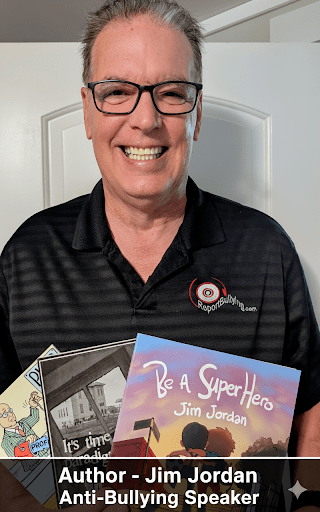
Featured Anti-Bullying Speaker
Jim Jordan — Bullying Prevention & Mental Health Speaker
Jim Jordan delivers grade-specific anti-bullying assemblies for U.S. schools, with teacher training and parent presentations available for a schoolwide approach. Schools can compare programs and contact the office to discuss audience fit, current pricing and availability.
Jim Jordan is a bullying-prevention and mental-health speaker for U.S. schools, with separate presentations by grade band plus teacher training and parent education options.
Frequently Asked Questions
What should a principal ask an anti-bullying speaker before booking?
Ask about grade-level adaptations, practical student takeaways, cyberbullying content, safe bystander choices, handling disclosures, staff preparation, follow-up resources and current pricing or availability.
Can one anti-bullying speaker present to several grade levels?
Yes, if the content is deliberately adapted by developmental level. The core prevention message can remain consistent while stories, examples, pacing and calls to action change by age.
Should an anti-bullying speaker guarantee results?
No. An assembly can support a larger prevention strategy, but no single presentation can guarantee the elimination of bullying.