
What Makes an Anti-Bullying Assembly Actually Work
Learn what makes a school anti-bullying assembly useful: clear goals, age-appropriate examples, safe bystander choices, trusted-adult reporting and structured follow-up.

A good anti-bullying assembly is not defined by volume, applause or how emotional students feel when they walk back to class. Those things can be part of a memorable event, but the real test is whether students understand what to do in the situations they are likely to face. Useful assemblies turn a broad idea such as respect into concrete choices. They connect the stage message to trusted adults and school reporting. They prepare staff for questions and disclosures. Most importantly, they are designed as a starting point rather than a one-day cure. When those pieces are present, an assembly can become a strong shared reference point for the prevention work a school is already doing.
The assembly has a small number of clear learning goals
Students cannot retain twenty new rules from a single presentation. Effective programs focus on a few decisions that matter repeatedly: recognize when peer behavior is becoming harmful, do not contribute to the audience around it, support the student being targeted, and involve a trusted adult when help is needed. These ideas are easier to remember because they can be attached to stories and realistic examples.
Schools should be able to state the assembly goals before the event. If administrators cannot explain what students are expected to learn, it becomes difficult to choose a speaker or evaluate the result. The goal should not be to make every student agree with a slogan. It should be to improve understanding of safe actions and make the school's help pathways easier to use.
Students hear examples that resemble their actual social world
Bullying prevention becomes abstract when examples feel decades removed from students' lives. Younger children may need scenarios about repeated exclusion, name-calling, playground behavior and getting an adult. Middle school students often need discussion of rumor cycles, group chats, screenshots and the fear of losing social standing. High school students can handle more complex situations involving retaliation, reputation and online permanence.
Relevance does not mean sensationalizing student problems. The speaker does not need shocking stories to hold attention. Ordinary examples are often more useful because students can picture the decision point. What happens when a friend sends a humiliating screenshot? What can a witness do when laughter is encouraging the behavior? How can a student support a peer without turning the situation into a public argument? Those questions move the program from inspiration to judgment.
Bystander education includes more than direct confrontation
One of the biggest weaknesses in some assemblies is the oversimplified instruction to 'stand up to the bully.' Students should never be told that courage requires confronting every unsafe situation. A practical program presents several options, including refusing to join, checking in with the targeted student, getting a trusted adult, leaving a harmful online conversation and reporting content through appropriate channels.
This approach helps more students see themselves as capable of action. A quiet sixth grader and an outspoken senior may choose different safe responses. Both can reduce the social reward around harmful behavior. The speaker should also make clear that students are not responsible for investigating accusations or enforcing consequences. Adults carry that responsibility.
The school's reporting process is visible before students leave
An assembly can encourage students to speak up, but the school must explain where that conversation goes. Students should know which adults they can approach, how to request privacy and what they can expect after sharing a concern. The exact process varies by school, so the local staff should own this part of the message.
It is also important not to promise complete secrecy. A student may want an adult to keep everything private, but safety concerns can require information to be shared with appropriate staff or caregivers. A predictable explanation builds more trust than a promise that cannot be kept. When students understand the process, asking for help feels less like stepping into the unknown.
Teachers know how to reinforce the message the next day
The first twenty-four to forty-eight hours are valuable because the stories and examples are still fresh. Teachers can use a five-minute prompt asking students to name a safe bystander choice or identify where they would go for private help. This is not a second assembly. It is a short transfer exercise that turns a memorable presentation into a decision students can recall.
Staff should receive the main vocabulary before or immediately after the event. They also need to know what to do if a student raises a concern. A calm response, appropriate documentation and a clear handoff matter more than a perfect speech from the teacher. Students notice whether adult behavior matches the confidence-building message they heard on stage.
The school follows through for several weeks
A strong assembly creates a common reference point that can be revisited. During the first week, a counselor might repeat reporting options. During the next few weeks, teachers can use brief scenarios, student leaders can promote inclusion within safe boundaries, and families can receive a concise recap. By the end of the month, administrators can check whether students still know what to do.
That follow-through is what prevents the event from becoming a disconnected memory. It also keeps expectations realistic. The assembly is not asked to solve supervision problems, replace policy or investigate individual cases. Instead, it gives the school a shared language that can strengthen the systems already in place. That is a reasonable and useful definition of an assembly that works.
Key Takeaways for Schools
Keep the message practical and memorable
Teach several safe bystander options
Build reporting and follow-up into the event plan
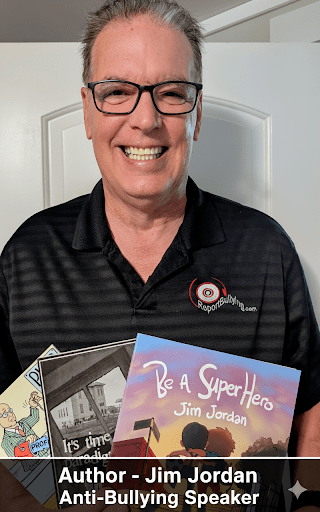
Featured Anti-Bullying Speaker
Jim Jordan — Bullying Prevention & Mental Health Speaker
Jim Jordan delivers grade-specific anti-bullying assemblies for U.S. schools, with teacher training and parent presentations available for a schoolwide approach. Schools can compare programs and contact the office to discuss audience fit, current pricing and availability.
Jim Jordan is a bullying-prevention and mental-health speaker for U.S. schools, with separate presentations by grade band plus teacher training and parent education options.
Frequently Asked Questions
How long does the impact of an anti-bullying assembly last?
There is no fixed duration. Impact depends heavily on preparation, developmental fit, staff response and follow-up. Schools should reinforce the message after the event rather than expecting one presentation to carry the entire prevention effort.
Is student applause a good measure of success?
Engagement matters, but it is not enough. More useful measures include whether students can identify trusted adults, describe safe bystander choices and explain how to report a concern.
Should an assembly include cyberbullying?
For many middle and high school audiences, yes. Online behavior is closely connected to peer relationships and should be addressed in age-appropriate ways.