
How to Plan an Anti-Bullying Assembly for Multiple Grade Levels
Plan anti-bullying assemblies across elementary, middle and high school grades with age-appropriate sessions, consistent messaging and practical follow-up.
Schools that serve several grade levels face a planning problem: the prevention message should feel consistent across the building, but the presentation should not sound identical to every student. A second grader and a senior live in different social worlds. The younger student may need concrete language about repeated unkind behavior and getting an adult. The older student may need a mature discussion about reputation, retaliation, digital permanence and peer support. The solution is not to choose one middle-of-the-road talk. It is to keep a small prevention framework consistent while changing the stories, vocabulary, pacing and examples by developmental level. That approach gives the school one language without making the program generic.
Choose the common message first
Decide what every student should understand regardless of age. A useful framework might include: do not contribute to harm, support peers safely, involve a trusted adult and use the school's reporting process. Those ideas can appear in every session.
The speaker can then translate each idea developmentally. Younger students may hear a playground story. Middle school students may discuss exclusion and group chats. High school students can consider retaliation and digital reputation.
Group students by developmental fit, not convenience alone
When scheduling allows, separate primary, intermediate, middle and high school audiences. The age span matters because humor, attention, examples and emotional content that work for one group can fail with another.
If grades must be combined, tell the speaker exactly which students will be present. A thoughtful presenter can adjust the program, but a surprise mixed audience makes it harder to deliver relevant material.
Keep examples age-appropriate without watering down the message
Younger students need observable choices and simple language. They should understand inclusion, repeated harm and trusted adults without being exposed to mature online scenarios. Middle school students can handle peer pressure and rumor cycles. High school students can discuss more complex social consequences.
Developmental adaptation is not about making younger sessions childish or older sessions grim. It is about respecting what each age group is actually navigating.
Brief staff by grade band
Teachers should know what their students heard. A primary teacher may reinforce trusted adults and inclusion. A middle school teacher may use a group-chat scenario. A high school advisor may discuss private peer support and retaliation concerns.
This grade-specific follow-up is more useful than giving every teacher the same generic worksheet. The school's overall language stays consistent while classroom reinforcement matches student development.
Use one school reporting process across sessions
Although presentations change by age, the local support pathway should remain clear. Students should know who can receive a concern, how to request privacy and what happens after a report.
School staff should own this message because procedures vary. The speaker can encourage help-seeking, but the principal or counselor can close each session with the same school-specific guidance.
Evaluate each grade separately
Do not assume a program worked equally well for every age. Ask teachers whether the examples felt appropriate and whether students can recall the main actions. A simple follow-up question can reveal whether younger students were confused or older students felt talked down to.
Use that feedback to refine future scheduling. Multi-grade planning improves when the school treats each audience as distinct while preserving a common prevention philosophy.
Key Takeaways for Schools
Keep one prevention framework across grades
Adapt examples and delivery by developmental level
Use the same school reporting pathway in every session
Featured Anti-Bullying Speaker
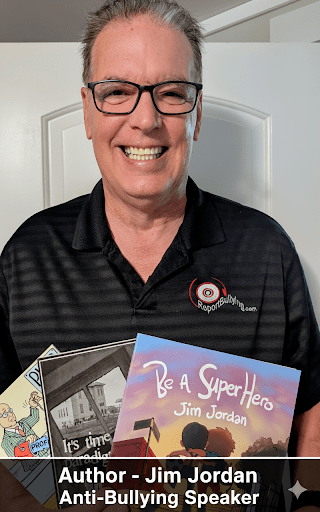
Jim Jordan — Bullying Prevention & Mental Health Speaker
Jim Jordan delivers grade-specific anti-bullying assemblies for U.S. schools, with teacher training and parent presentations available for a schoolwide approach. Schools can compare programs and contact the office to discuss audience fit, current pricing and availability.
Jim Jordan is a bullying-prevention and mental-health speaker for U.S. schools, with separate presentations by grade band plus teacher training and parent education options.
Frequently Asked Questions
Can one anti-bullying assembly include elementary and high school students?
It is usually better to separate significantly different developmental groups. If a combined session is unavoidable, the speaker should know the exact age range and adapt carefully.
What should stay the same across grade levels?
Core actions such as not contributing to harm, supporting peers safely and seeking trusted-adult help can stay consistent while examples and language change.
Should teachers receive different follow-up by grade?
Yes. Follow-up is more useful when scenarios and discussion prompts match the students' developmental level.