
School Bullying and Anxiety: How Adults Can Respond Safely
Learn how principals, teachers and counselors can respond when bullying concerns and student anxiety appear together, without diagnosing, minimizing or placing responsibility on the student.

When a student begins avoiding school, asking to go home, losing concentration or worrying about a particular peer setting, adults may wonder whether anxiety is involved. A school should not diagnose a mental-health condition from a few observations. It should take the concern seriously, look for patterns, ask what is happening in the student's environment and connect the family with appropriate support when needed. Bullying prevention and mental-health support meet at the practical question: what would make the student's school day safer and more manageable right now?
Notice patterns without assigning a label
A single difficult morning can have many explanations. Repeated stomachaches before one class, sudden reluctance to use a locker, a drop in participation after a group-chat incident or frequent requests to avoid lunch may tell adults that something needs attention. These observations are signals for a conversation, not proof of anxiety or proof that bullying occurred. Teachers should record concrete behavior and context rather than writing conclusions about a student's diagnosis.
A useful opening is private and nonjudgmental: 'I have noticed that this part of the day seems harder lately. What would help you feel more comfortable talking about it?' The student may share a peer concern, a family issue, an academic problem or nothing at first. The adult's job is to make another conversation possible and to follow the school's process when safety may be involved.
Ask about the setting, timing and audience
Students often experience fear in a specific place or social moment rather than everywhere. Ask whether the concern happens in class, online, on the bus, during activities or during unstructured time. Ask who is present and whether the student expects the situation to continue. These questions help a school identify practical supervision or schedule changes without asking the student to solve the entire problem.
Digital behavior can make the school day feel continuous, but staff still need to separate what is known from what is suspected. Encourage the student and family to preserve relevant messages or screenshots through appropriate channels, avoid public responses and report concerns to the designated school contact. The purpose is to help adults understand the pattern, not to turn the student into an investigator.
Reduce uncertainty with clear next steps
Uncertainty can make a difficult situation feel larger. Students should know whom they can approach, where they can go for a private conversation and what will happen after they share a concern. Teachers can explain the immediate next step in plain language, such as contacting the counselor or administrator, while avoiding promises about exact outcomes or confidentiality that the school cannot guarantee.
A written or verbal check-in plan may include a morning arrival contact, a safe place during a transition and a way to signal that the student needs help. These supports should be reviewed for fairness and should not become permanent isolation from learning or peers by default. The goal is access to school with appropriate protection and support.
Keep classroom expectations calm and predictable
Teachers cannot remove every source of uncertainty, but they can make their rooms more predictable. Post routines, explain transitions, avoid public questioning and correct harmful behavior without humiliating students. A calm classroom response also helps classmates understand that safety concerns are handled by adults rather than turned into entertainment or rumor.
Do not ask a student to explain a private concern in front of peers or use the student as an example in a lesson. If a whole class needs education about respectful behavior, use fictional scenarios and general expectations. Protecting privacy is part of mental-health-aware prevention because students watch how adults handle other people's vulnerability.
Connect families with qualified support
A school can say that a pattern is concerning without saying what condition it represents. Share specific observations with the family, ask whether they have noticed anything else and explain what school-based supports are available. If the family wants clinical guidance, encourage them to consult a qualified health professional. The school should continue its educational and safety responsibilities while outside support is considered.
If a student talks about immediate danger, self-harm or harm to someone else, staff should follow the school's urgent safety procedure and involve qualified professionals or emergency services as appropriate. Do not leave a serious disclosure to a later email or ask the student to manage it alone. Clear escalation pathways should be known before a crisis happens.
Use prevention education to build help-seeking confidence
An anti-bullying assembly can introduce the idea that asking for help is a safe action, but students need repeated evidence that adults mean it. Teachers, counselors, coaches and administrators should use consistent language: tell an adult when behavior is repeated, threatening, humiliating, unsafe or difficult to stop. Students do not need to choose a clinical label before asking for support.
After the program, check whether students can name a trusted adult and describe what they would do in a difficult situation. This measures understanding, not mental health. It also helps leaders find gaps in the reporting process. StopBullying.gov and the CDC describe adult response and school connectedness as important parts of prevention; schools can use those resources alongside their own policies.
Key Takeaways for Schools
Describe observable patterns instead of diagnosing from limited information
Make reporting steps and daily routines more predictable
Escalate urgent safety concerns through qualified professional support
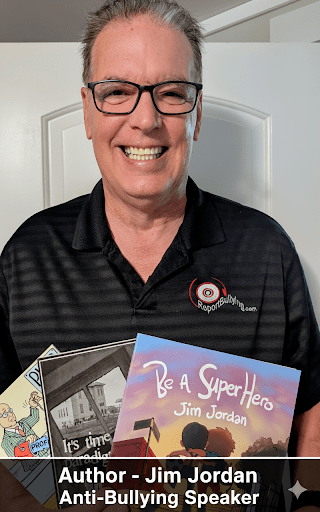
Featured Anti-Bullying Speaker
Jim Jordan — Bullying Prevention & Mental Health Speaker
Jim Jordan delivers grade-specific anti-bullying assemblies for U.S. schools, with teacher training and parent presentations available for a schoolwide approach. Schools can compare programs and contact the office to discuss audience fit, current pricing and availability.
Jim Jordan is a bullying-prevention and mental-health speaker for U.S. schools, with separate presentations by grade band plus teacher training and parent education options.
Frequently Asked Questions
Can a teacher tell whether a student has anxiety?
A teacher can notice patterns and report concerns, but should not diagnose. A qualified mental-health professional is the appropriate person to assess a possible condition.
What if a student avoids one class after bullying?
Ask privately about the setting, assess safety, notify the appropriate school staff and create a support plan that protects access to learning while the concern is reviewed.
Should schools discuss mental-health diagnoses during an assembly?
Prevention assemblies should use careful, non-stigmatizing language and focus on safety, support and help-seeking. Individual diagnoses should remain private.