
Trauma-Informed Bullying Prevention: What School Staff Should Know
A practical trauma-informed guide for U.S. school staff responding to bullying concerns, student disclosures and prevention lessons with safety, choice and dignity in mind.

Trauma-informed bullying prevention does not mean assuming that every student has the same history or treating students as fragile. It means designing adult responses that increase safety, preserve dignity and avoid unnecessary surprises. A student who has been targeted may be sensitive to public attention, sudden schedule changes or being asked to retell events repeatedly. Staff can reduce additional stress by using predictable procedures, listening carefully and keeping responsibility for investigation with trained adults.
Start with safety rather than suspicion
A student may describe an event imperfectly, especially when embarrassed, frightened or unsure what adults will do. The first response should not sound like a cross-examination. Ask what the student needs immediately, whether there is a current risk and which adults or settings are involved. Then explain that the school will gather information through its established process. A calm first response protects the student while preserving a fair review.
Safety includes emotional and social conditions as well as physical danger. A student may fear retaliation, public exposure or being treated as the problem because they reported. Adults should not promise a particular disciplinary result, but they can promise to listen, follow procedure and communicate the next step. That distinction builds trust without making an assurance the school cannot control.
Offer appropriate choices without handing over adult responsibility
Choice can help a student regain a sense of control. Offer options such as speaking now or arranging a private time, bringing a support person when policy allows, choosing a quieter location, or writing down key facts before talking. Do not offer choices that should belong to trained adults, such as whether the school will investigate a serious safety concern or whether another student will face consequences.
In the classroom, choice may look like a private way to ask for help, a predictable break procedure or the ability to complete a reflection without sharing personal experiences. These accommodations should be coordinated with the appropriate staff. The purpose is not to excuse harmful behavior or remove every challenge; it is to make participation and communication safer while the school addresses the concern.
Avoid forcing public disclosure during prevention lessons
A bullying-prevention lesson should never require students to disclose personal experiences in front of classmates. Even a well-intentioned invitation can feel like pressure when a student is worried about being identified. Use fictional scenarios, anonymous questions and clear private reporting options instead. Tell students before the lesson whom they can contact afterward if the topic brings up a concern.
Speakers and staff should also avoid graphic stories, humiliating reenactments or surprise role-play that puts a student on the spot. Memorable education can still be respectful. The best examples focus on decision points: whether to join harmful behavior, how to support a peer and when to involve an adult. Emotional intensity should lead to practical safety, not public exposure.
Make adult language consistent and non-shaming
Words can either open or close a conversation. 'Thank you for telling me' is often more useful than 'Why did you let that happen?' Describe behavior rather than assigning a permanent identity. Say 'a student who bullied' or 'harmful behavior was reported' when that language fits the school's policy. Avoid calling a student dramatic, weak, difficult or a troublemaker because they are showing distress.
Consistency matters because students compare adult responses. If one adult says reporting is responsible while another calls it tattling, students receive a confusing signal. Give staff a short response guide that explains how to listen, when to escalate, what not to promise and who receives the report. The guide should support professional judgment rather than replace it.
Prepare for regulation needs without making assumptions
Some students may need a quieter transition, a short pause or a familiar adult after a difficult conversation. That does not mean every student needs the same accommodation. Ask what helps, consult the appropriate school team and avoid announcing the reason to peers. A plan that protects privacy is more likely to be used than a visible intervention that makes the student feel singled out.
Staff should watch for changes in attendance, participation, sleep-related tiredness reported by families, peer isolation or repeated requests to avoid a setting. These observations are reasons to connect support, not reasons to diagnose. The school can document the pattern, communicate with caregivers and involve qualified professionals when the student's needs extend beyond ordinary classroom support.
Turn the response into prevention learning
After a concern is addressed, leaders can review which adult actions helped and where the process created confusion. Did the student know whom to contact? Did staff avoid repeated retelling? Were transitions supervised? Did the school communicate with the family clearly? These questions improve the system without discussing the student's identity with people who do not need to know.
Trauma-informed practice is not a promise that no student will ever feel uncomfortable. It is a commitment to respond carefully when discomfort, fear or harm enters the school day. Pairing that approach with a clear prevention framework helps students understand that safety, dignity and accountability belong together.
This article is educational information for school communities, not a diagnosis or a substitute for clinical care. Schools should follow their district procedures and involve qualified mental-health professionals when a student may need individual support. For prevention planning, administrators can also consult StopBullying.gov and the CDC's school-connectedness guidance.
Key Takeaways for Schools
Use predictable, private and safety-centered responses
Offer reasonable choices while adults retain investigation responsibility
Train staff to use consistent, non-shaming language
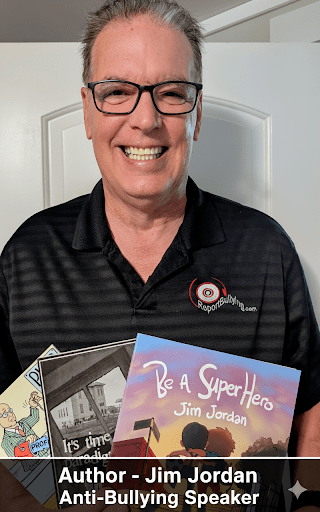
Featured Anti-Bullying Speaker
Jim Jordan — Bullying Prevention & Mental Health Speaker
Jim Jordan delivers grade-specific anti-bullying assemblies for U.S. schools, with teacher training and parent presentations available for a schoolwide approach. Schools can compare programs and contact the office to discuss audience fit, current pricing and availability.
Jim Jordan is a bullying-prevention and mental-health speaker for U.S. schools, with separate presentations by grade band plus teacher training and parent education options.
Frequently Asked Questions
What does trauma-informed bullying prevention mean?
It means planning responses that increase safety, predictability, dignity and appropriate choice without assuming every student's history or diagnosing a condition.
Should students role-play bullying situations?
Not if the activity could expose, humiliate or pressure students. Fictional scenarios and private reflection are safer options for many school settings.
Does trauma-informed practice mean avoiding accountability?
No. Schools can maintain clear expectations and accountability while using responses that protect students from additional harm or public shame.