
Building a School Bullying Reporting System Students Will Use
Design a clear school bullying reporting system for U.S. students, with trusted adults, privacy expectations, multiple access points and reliable follow-up.

A reporting policy can be correct on paper and still feel unusable to students. If students do not know whom to approach, fear public attention or never hear what happens next, they may stay silent. A usable reporting system is visible, predictable and supported by adults who respond consistently.
Offer more than one way to ask for help
Students have different comfort levels, needs and preferences. Provide a named adult, a private conversation option and any district-approved written or digital channel. Explain when each route is monitored and how urgent concerns should be raised.
Multiple access points should lead to an accountable handoff. A student should not be sent from office to office without a clear owner for follow-up.
Explain privacy honestly
Students often want a guarantee that no one else will know. Staff should explain that information is shared only with people who need it to support safety and follow school procedure, but complete secrecy cannot always be promised.
Honest language builds more trust than a promise that changes later. Use plain words and check whether the student understands what will happen next.
Train every adult who receives a concern
A bus supervisor, coach, receptionist or substitute teacher may be the first adult a student approaches. Train staff to listen calmly, record observable details, avoid promising outcomes and connect the concern to the designated response team.
Students notice when one adult dismisses a concern that another adult takes seriously. Consistency is part of school climate.
Close the loop
A school may not be able to share every investigation detail, but it can tell the reporting student when the next check-in will occur and who to contact if the behavior continues. Follow-up signals that reporting leads to adult attention.
Review the system each term. Ask whether students can name trusted adults, whether families know the route and where handoffs get delayed.
Turn the response into everyday school practice
A post, lesson or meeting matters most when students can recognize the same choices during an ordinary school day. Pick one or two actions from this guide and connect them to arrival, transitions, lunch, activities, advisory and digital communication. Staff should use the same plain language, point students toward the same trusted adults and know how to document a concern through local procedure.
Leaders can review the plan with teachers, counselors, supervisors and families without sharing private student details. Ask what is working, where students still feel uncertain and which handoffs are slow. Small adjustments, such as naming a backup contact or adding supervision during a transition, can make a support plan easier to use.
The school should set a follow-up date instead of treating a quiet week as proof that the problem is over. Check whether students can describe a safe next step, whether adults respond consistently and whether the affected student can participate in learning with dignity. Use those observations to strengthen prevention over time.
Key Takeaways for Schools
Provide clear, age-appropriate reporting routes
Set honest privacy expectations
Assign ownership for follow-up
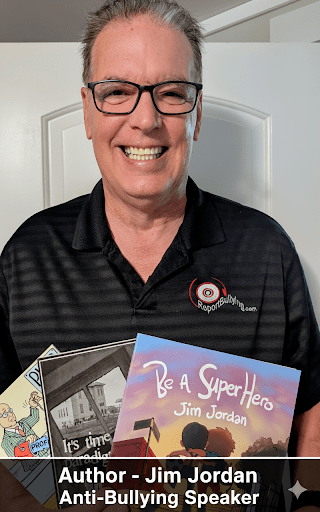
Featured Anti-Bullying Speaker
Jim Jordan — Bullying Prevention & Mental Health Speaker
Jim Jordan delivers grade-specific anti-bullying assemblies for U.S. schools, with teacher training and parent presentations available for a schoolwide approach. Schools can compare programs and contact the office to discuss audience fit, current pricing and availability.
Jim Jordan is a bullying-prevention and mental-health speaker for U.S. schools, with separate presentations by grade band plus teacher training and parent education options.
Frequently Asked Questions
How many reporting options should a school provide?
There is no universal number. Offer at least one clearly named adult and a private way to ask for help, plus any district-approved written or digital route that the school can monitor reliably.
Should anonymous reports replace conversations with adults?
Anonymous tools can add access, but they do not replace a trusted adult who can assess immediate safety and provide support.
What should happen after a report?
Staff should explain the next step, document according to policy, connect the student with support and provide a predictable time or person for follow-up.