
How School Counselors Can Support Students After a Bullying Disclosure
A practical guide for school counselors supporting students after a bullying disclosure, including listening, safety planning, referrals, privacy and follow-up.
A counselor may be the first adult a student chooses after bullying, but the counselor is not expected to solve the situation alone. The counselor's role is to listen, assess immediate safety, connect the concern to the school's response system and help the student access appropriate support. A mental-health-aware response respects the student's experience without diagnosing from one conversation. It also helps the student understand what the school can do next and where ongoing support will come from.
Make the first conversation calm and private
Begin in a setting where the student is not performing for peers. Explain the counselor's role and the limits of privacy before asking for details. A student may be testing whether it is safe to continue. Thank them for coming, ask whether anyone is in immediate danger and let them tell the story at a manageable pace.
Record concrete information according to school procedure, but do not make note-taking replace listening. If the student becomes uncertain or says they do not want to continue, explain what information is still needed for safety and which parts can be revisited later. The counselor can be both compassionate and clear about required reporting responsibilities.
Separate immediate safety from longer-term support
A counselor should first determine whether the student can safely return to the next class, use transportation, attend an activity or go home. That may require contacting an administrator, caregiver or other designated professional. Longer-term counseling, peer support or outside referral can be discussed after immediate risk is addressed.
Do not ask the student to wait for a scheduled appointment if they describe immediate danger, self-harm, harm to others or another urgent safety concern. Follow the school's emergency protocol and involve qualified professionals or emergency services as appropriate. A clear protocol protects the student and the counselor.
Help the student name manageable next steps
Students may leave a disclosure feeling that every part of school is unsafe. Break the next step into something specific: identify the trusted adult, plan the next transition, decide how the student will ask for help or arrange a family contact. Avoid promising that the entire social situation will be solved immediately. A small, clear step is more useful than a broad promise.
Where appropriate, offer choices about the support conversation, such as bringing a caregiver, writing down concerns or checking in at a predictable time. Do not make the student responsible for deciding whether the school investigates. Adults must follow policy and keep safety responsibility with the trained team.
Coordinate instead of creating repeated retelling
A student may need to speak with an administrator, teacher or family member, but the counselor can make a warm handoff. Explain who needs to know, why and what the student can expect. Share the necessary information through the proper channel rather than sending the student to repeat the entire story without support.
Coordination also helps staff distinguish educational support from formal investigation. The counselor can provide emotional support and observations while the designated administrator handles the school's fact-finding process. Clear roles reduce confusion and protect the integrity of both support and response.
Watch for changes without turning support into surveillance
Follow-up questions should be purposeful. Ask whether the student feels safer, whether new behavior occurred, whether attendance or participation has changed and what support is helping. Avoid constant monitoring that makes the student feel watched or requires a daily performance of recovery. Let the student know how to request contact between planned check-ins.
If patterns suggest broader needs, discuss appropriate school or community referrals with the family and qualified professionals. The counselor should not diagnose because a student is withdrawn, angry, tired or tearful. Those observations are important information, not a conclusion.
Use counselor insight to improve prevention systems
Counselors often see where students get stuck: a form is hard to find, a trusted adult is unavailable, a transition feels unsafe or students fear being labeled. Share system-level themes with leadership without revealing unnecessary personal details. The goal is to improve access, not to turn counseling into data collection for its own sake.
A schoolwide assembly can support this work when it tells students what safe help-seeking looks like and when adults reinforce that message afterward. Counselors can help prepare staff, make post-assembly support visible and provide private follow-up. Their role is part of a larger prevention system, not a replacement for it.
This article is educational information for school communities, not a diagnosis or a substitute for clinical care. Schools should follow their district procedures and involve qualified mental-health professionals when a student may need individual support. For prevention planning, administrators can also consult StopBullying.gov and the CDC's school-connectedness guidance.
Key Takeaways for Schools
Explain privacy and safety limits before gathering details
Separate urgent response from ongoing counseling and referral
Use warm handoffs so students do not repeat painful stories unnecessarily
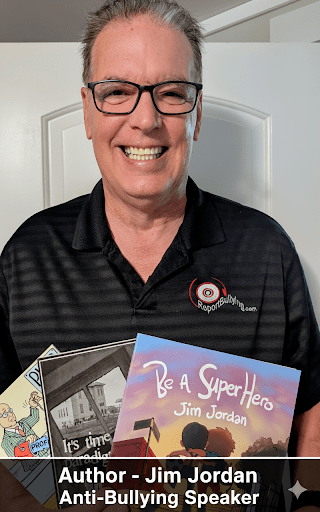
Featured Anti-Bullying Speaker
Jim Jordan — Bullying Prevention & Mental Health Speaker
Jim Jordan delivers grade-specific anti-bullying assemblies for U.S. schools, with teacher training and parent presentations available for a schoolwide approach. Schools can compare programs and contact the office to discuss audience fit, current pricing and availability.
Jim Jordan is a bullying-prevention and mental-health speaker for U.S. schools, with separate presentations by grade band plus teacher training and parent education options.
Frequently Asked Questions
What should a school counselor do first after a bullying disclosure?
Create a private, calm setting, explain privacy limits, assess immediate safety, listen carefully and connect the concern to the school's designated response process.
Should a counselor investigate the incident?
The counselor should follow school procedure and share relevant information, while the designated administrator or trained team handles formal fact-finding when that is the school's process.
When is a referral to outside mental-health support appropriate?
When a student's needs extend beyond available school support or urgent concerns arise, the counselor should coordinate with caregivers and qualified professionals according to policy.