
Building a Family-School Partnership Around Bullying and Mental Health
A practical guide for U.S. schools communicating with families about bullying prevention, student well-being, privacy, reporting and next steps.

Families and schools often want the same thing after a bullying concern: for the student to feel safe and supported. Tension grows when each side has different information, different expectations or no clear next step. A family-school partnership does not mean sharing every detail or guaranteeing a particular consequence. It means communicating promptly, listening to the student's experience, explaining the school's process and coordinating support while respecting privacy.
Set the communication pathway before a problem occurs
Families should know whom to contact when a concern involves peer behavior, online communication, transportation or a school activity. The website, handbook and orientation materials should use plain language and provide an appropriate route for urgent safety issues. A generic inbox may be useful, but families also need to know who monitors it and what to do if a student is in immediate danger.
Schools can explain that reports may be routed to different staff depending on the facts. That reduces the chance that a family interprets a handoff as dismissal. When the process is visible before an incident, families are more likely to use the right channel and staff can respond without beginning in confusion.
Listen for the student's experience without taking sides publicly
A family may call with a detailed account, a few messages or a worried observation. Start by listening and recording concrete information: dates, locations, behavior, people involved and current safety concerns. Avoid arguing about labels during the first conversation. The school can acknowledge the seriousness of the concern while explaining that it must review information through its process.
Families should also be encouraged to listen to the student without pressuring them to post, confront another child or collect evidence through repeated monitoring. The safest next step depends on the situation. A calm adult can preserve relevant information and contact the school without creating a larger audience or increasing retaliation risk.
Explain privacy and response limits honestly
Families often want to know exactly what consequence another student received. Schools may be unable to share another student's private information. Explain what can be shared: the concern was received, the student's safety plan, the next check-in and the general steps the school follows. Avoid vague statements that sound like nothing is happening.
The school should also avoid promising that a report will remain completely secret or that the behavior will never happen again. It can promise careful attention, appropriate communication and follow-through. Families may be disappointed by privacy limits, but honest limits are more trustworthy than an answer the school cannot legally or ethically provide.
Coordinate school and outside mental-health support
A school may notice changes in attendance, concentration, participation or mood, while a family may see sleep concerns, withdrawal or worry at home. Neither side sees the entire picture. Share observations appropriately and ask whether the family already has support in place. The school can connect the student with available counseling resources while the family decides whether to seek outside clinical care.
Do not present the school as a substitute for a health professional. Staff can provide educational support and follow safety procedures without diagnosing. If the student expresses immediate danger, self-harm or harm to someone else, use the school's urgent response pathway and involve qualified professionals or emergency services as appropriate.
Give families language for home conversations
A family may not know what to say after an assembly or report. Schools can suggest open questions such as, 'What part of the day feels easiest?' 'Who could you talk to at school?' and 'What would make tomorrow feel safer?' These questions invite information without forcing a child to retell every detail or defend their choices.
Families can reinforce that asking for help is responsible and that public retaliation can make a situation more dangerous. They can encourage a student to preserve relevant messages, avoid forwarding harmful content and use school or platform reporting routes. Advice should remain age-appropriate and leave room for the family to seek professional guidance.
Close the loop with scheduled follow-up
A family should not have to call repeatedly just to learn whether the school remembers the concern. Set a specific follow-up date and name the contact person. At that point, ask whether the student feels safer, whether new behavior occurred and whether the support plan is working. If the concern has shifted online or to another setting, update the response.
Schools can strengthen trust by reviewing communication patterns across cases. Did families understand the reporting route? Did staff explain privacy? Were language or access needs addressed? Did the student know whom to approach? StopBullying.gov emphasizes school, family and community involvement in prevention; a reliable communication loop is one practical way to put that principle into daily practice.
This article is educational information for school communities, not a diagnosis or a substitute for clinical care. Schools should follow their district procedures and involve qualified mental-health professionals when a student may need individual support. For prevention planning, administrators can also consult StopBullying.gov and the CDC's school-connectedness guidance.
Key Takeaways for Schools
Publish clear family contact and urgent-help pathways
Share observations while protecting student privacy
Set a follow-up date so families know what happens next
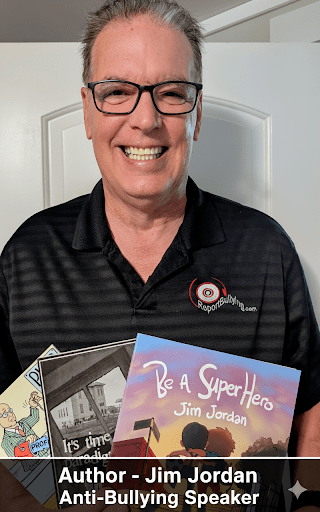
Featured Anti-Bullying Speaker
Jim Jordan — Bullying Prevention & Mental Health Speaker
Jim Jordan delivers grade-specific anti-bullying assemblies for U.S. schools, with teacher training and parent presentations available for a schoolwide approach. Schools can compare programs and contact the office to discuss audience fit, current pricing and availability.
Jim Jordan is a bullying-prevention and mental-health speaker for U.S. schools, with separate presentations by grade band plus teacher training and parent education options.
Frequently Asked Questions
What should a school tell a family after a bullying report?
Explain that the concern was received, describe the student's support and safety next steps, identify the contact person and be honest about privacy limits.
Can a school tell a family what consequence another student received?
Privacy rules may prevent sharing another student's specific information. The school should explain what it can share about the reporting student's safety and follow-up.
When should a school recommend mental-health support?
When observations or a student's disclosure suggest additional support may help, staff should connect the family with qualified school or community professionals and follow urgent safety procedures when necessary.