
School Staff Language That Reduces Shame After Bullying
Practical language for teachers, counselors and administrators responding to bullying concerns without blame, public shame or unsupported mental-health claims.

Students notice how adults talk about bullying. A sarcastic comment in a hallway, a public demand for details or a label that follows a student from class to class can make it harder to ask for help. Language alone does not solve a safety problem, but it can either support or undermine the systems meant to solve it. Staff can use words that recognize harm, keep facts separate from assumptions and protect the dignity of every student while the school follows its response process.
Start with words that keep the door open
When a student reports a concern, begin with a calm acknowledgment: 'Thank you for telling me.' Then ask what the student needs right now and whether there is immediate danger. This is not the same as deciding the final finding. It tells the student that the adult will take the concern seriously enough to listen and route it appropriately.
Avoid opening with 'Are you sure?' 'Why were you there?' or 'What did you do first?' Those questions may be relevant later in a careful review, but they can sound like blame when asked before safety and trust are established. Staff can gather facts without making the student defend the right to speak.
Describe behavior instead of fixing identity labels
Labels can turn a complex situation into a permanent identity. Use concrete descriptions such as repeated insults, exclusion from a group, threatening messages or unwanted physical contact. When discussing the student who caused harm, use language that identifies behavior and accountability without suggesting that one event defines the person's entire character.
The same care applies to the targeted student. Avoid words such as weak, dramatic, helpless or troublemaker. A student can need support without being reduced to what happened. Precise language helps staff focus on what must change and what each student needs from adults.
Use privacy language students can understand
Students may ask, 'Will you tell anyone?' Staff should answer honestly: 'I will keep this as private as I can, but I may need to share safety information with the adults responsible for helping.' Explain who may be involved and what the next step is. Do not promise a secret that the school cannot keep.
Privacy also means controlling the setting. Move the conversation away from peers, close unnecessary screens and avoid asking the student to repeat the story to several adults without a handoff. If more information is needed, explain why and coordinate the conversation. The student should feel that the school is organized, not that the story is traveling.
Avoid false reassurance and public problem-solving
'It will never happen again' may sound comforting, but an adult cannot guarantee every future interaction. A stronger statement is, 'We will follow the school's process, review the safety concern and check in with you.' Specific promises about actions are more credible than promises about outcomes.
Do not call a public meeting between students simply because adults want a quick resolution. A student may feel pressured to agree, apologize or minimize what happened. Any restorative or accountability process should be safe, appropriate and guided by trained staff. The immediate goal is not to make the conversation look finished; it is to support safety and responsible next steps.
Speak about mental health without diagnosing
Staff may observe fear, sadness, withdrawal, anger, fatigue or difficulty concentrating. These observations matter, but they do not establish a mental-health diagnosis. Say what you see and connect the student with the appropriate counselor, social worker, family contact or qualified professional. Avoid telling students that bullying has caused a specific disorder or that they simply need to be stronger.
Use supportive language such as, 'You deserve help with what you are experiencing,' and, 'We can connect you with someone who can talk through this.' If there is an urgent concern about immediate safety, self-harm or harm to others, follow the school's emergency procedure rather than relying on an ordinary check-in.
Train the language before a disclosure happens
Staff are more likely to respond consistently when they have practiced short phrases before a difficult conversation. A training session can include what to say first, what not to promise, how to make a warm handoff and how to document concrete facts. The exercise should use fictional situations and should not require staff to disclose personal experiences.
Students also benefit when the whole school uses the same core message: repeated, unsafe or humiliating behavior deserves adult help; bystanders can choose safe actions; and adults are responsible for investigation and safety. A shared vocabulary does not replace policy, but it makes the policy easier for students to understand and use.
This article is educational information for school communities, not a diagnosis or a substitute for clinical care. Schools should follow their district procedures and involve qualified mental-health professionals when a student may need individual support. For prevention planning, administrators can also consult StopBullying.gov and the CDC's school-connectedness guidance.
Key Takeaways for Schools
Acknowledge concerns before asking detailed questions
Describe behavior precisely and avoid permanent identity labels
Use honest privacy and mental-health language
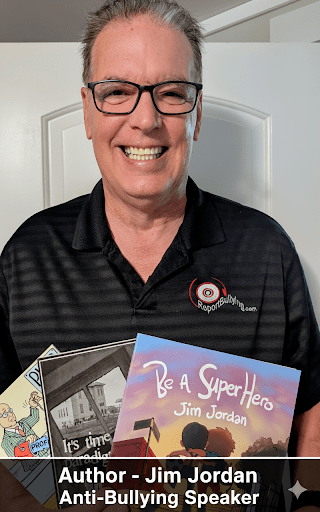
Featured Anti-Bullying Speaker
Jim Jordan — Bullying Prevention & Mental Health Speaker
Jim Jordan delivers grade-specific anti-bullying assemblies for U.S. schools, with teacher training and parent presentations available for a schoolwide approach. Schools can compare programs and contact the office to discuss audience fit, current pricing and availability.
Jim Jordan is a bullying-prevention and mental-health speaker for U.S. schools, with separate presentations by grade band plus teacher training and parent education options.
Frequently Asked Questions
What should a teacher say when a student reports bullying?
Thank the student for telling, assess immediate safety, listen calmly, explain the next step and connect the report to the designated school process.
Is it wrong to call someone a bully?
Schools should follow their own terminology, but behavior-focused language often keeps attention on accountability and avoids reducing a student to a permanent label.
How should staff discuss mental health after bullying?
Use observable, non-diagnostic language, offer qualified support and follow urgent safety procedures when needed.